“How do I email all of my members?” and “How do I email my members in this one level?” are two of the questions our support team hears most often. You go looking for a Send to Members button in the WordPress admin, and there isn’t one.
Both questions have the same answer. Paid Memberships Pro (PMPro) connects to your email marketing tool and keeps it in sync with your membership levels. Once that connection is in place, you email your membership site members from your email tool, either all of them at once or one level at a time. This guide explains how that works, then walks through the full setup using MailerLite as the example.

How Emailing Your Members Works in PMPro
PMPro tells your email tool which members belong to which membership level, and keeps that information current as memberships change. The newsletters and bulk marketing email go out from the email tool.
When someone is assigned a specific level, the integration adds them to a matching list or group in your email tool. When they upgrade, cancel, or expire, the integration updates their list membership. You never export a spreadsheet to find out which members are in each level, because your email tool already knows.
Sending is a separate step that happens inside your email tool:
- To email all of your members, send a campaign to every membership group.
- To email a single level, send the same kind of campaign to one group.
You set up the sync once, and it covers both jobs.
Email marketing tools are built for the work that bulk sending requires (throttling, deliverability, unsubscribe handling, bounce tracking, and reporting), and WordPress isn’t set up for any of it. If you’ve been considering sending bulk email straight from WordPress with a basic SMTP plugin, please don’t. You could end up in spam folders, get a flag on your domain, and risk breaking the password resets and renewal notices your site depends on.
Marketing Email and Transactional Email Take Different Paths
This post is about marketing email: newsletters, announcements, promotions, and anything else you choose to send to a group. Transactional email is different. Checkout confirmations, receipts, password resets, and expiration warnings are triggered by something a single member does, and PMPro sends them from your site automatically.
Transactional email still needs a reliable sending path. Route it through an authenticated SMTP service with the free SMTP Integration Add On, and set up SPF, DKIM, and DMARC for your domain. If your hosting is PMPro Max, transactional email sending is included.
Choose Your Email Tool
You have more options than a single list of logos suggests. The choices fall into three groups, and the right one depends on what you already use and how much of your stack you want inside WordPress.
An Email Service With a Native PMPro Integration
This is the easiest setup and the one we recommend for most sites. PMPro has free integration Add Ons for Mailchimp, MailerLite, Kit (formerly ConvertKit), AWeber, Constant Contact, and Keap. Each one maps your membership levels to lists, groups, or tags in that service, and the service handles all of the sending. You can browse all of them in the email Add Ons category.
Email From Inside WordPress
Some site owners want to write and send email without leaving the WordPress dashboard. MailPoet has a free PMPro integration that maps levels to MailPoet lists, and MailPoet can send through its own sending service. FluentCRM connects to PMPro from its Pro version, and Newsletter Glue turns the block editor into a newsletter builder with its own PMPro setup guide.
The trade-off is that deliverability depends on the sending service each tool is connected to. A simpler stack is appealing, so make sure your bulk mail goes out through a real sending service and not your web server.
Anything Else, Through WP Fusion
If you’re committed to an email tool that PMPro doesn’t integrate with directly (ActiveCampaign, HubSpot, Drip, and dozens more), WP Fusion is the bridge. WP Fusion is a separate plugin that connects WordPress to CRMs and email tools. Its paid plans include a PMPro integration that applies tags by level, cancellation, expiration, and failed payment. Paid Memberships Pro also has native Zapier support if you’d rather build the connection there.
Connect PMPro to MailerLite
For the rest of this guide, we’ll use the free MailerLite Integration as the example. The steps look almost the same in Mailchimp, Kit, or any of the other integrations. Only the labels in each tool change.
You’ll need PMPro installed with at least one membership level, and a MailerLite account. MailerLite’s free plan is enough to test everything below.
Install the MailerLite Integration
In the WordPress admin, navigate to Memberships > Add Ons, search for MailerLite, then install and activate the MailerLite Integration. A new MailerLite settings screen appears under Memberships.
Connect Your MailerLite API Key
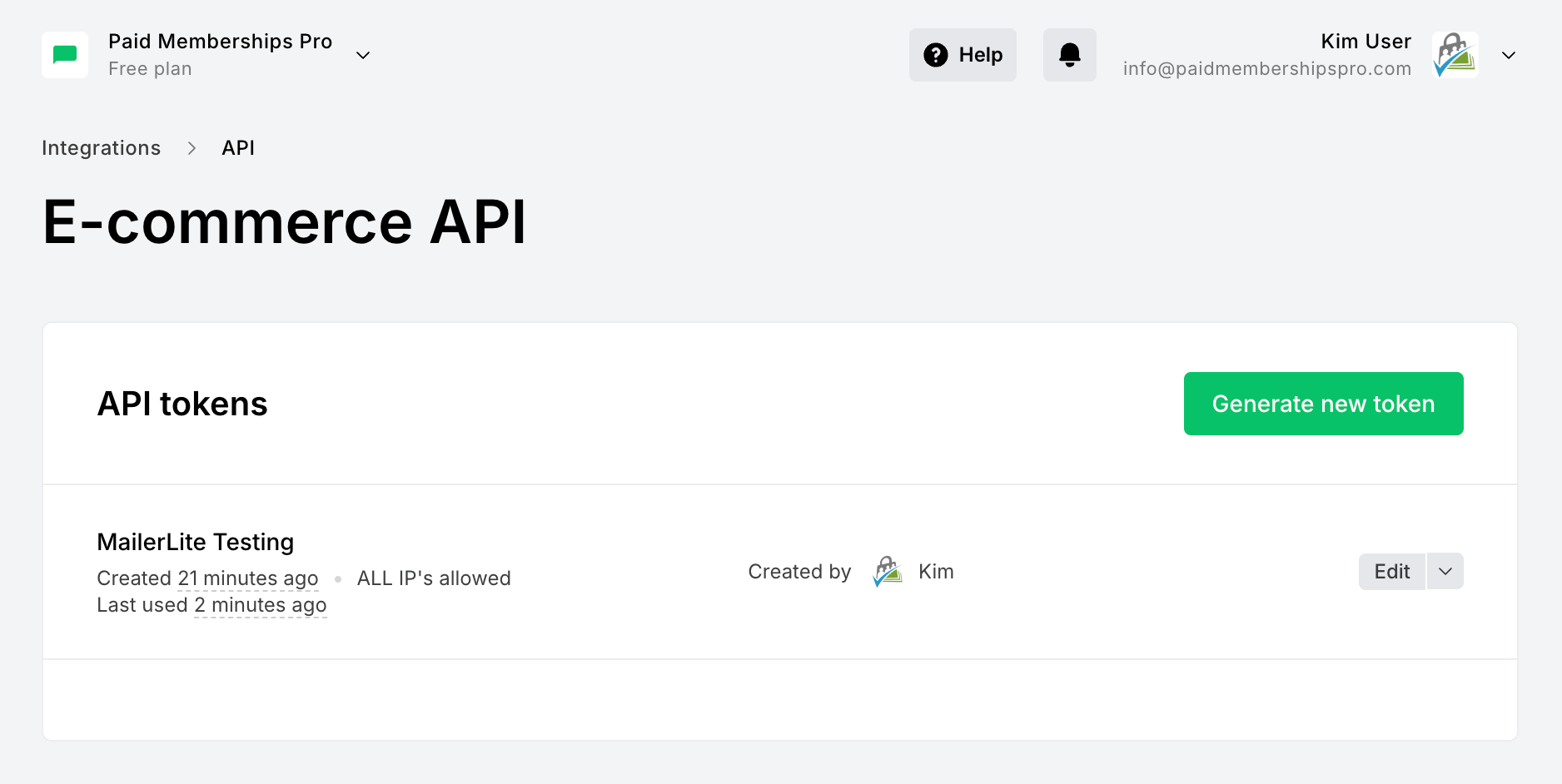
The Add On talks to your MailerLite account with an API key. In MailerLite, navigate to Integrations > API and click Generate new token.
Give the token a name you’ll recognize later, like the name of your site, then copy it. Return to Memberships > MailerLite in WordPress, paste it into the API Key field, and save.
Create a Group for Each Membership Level
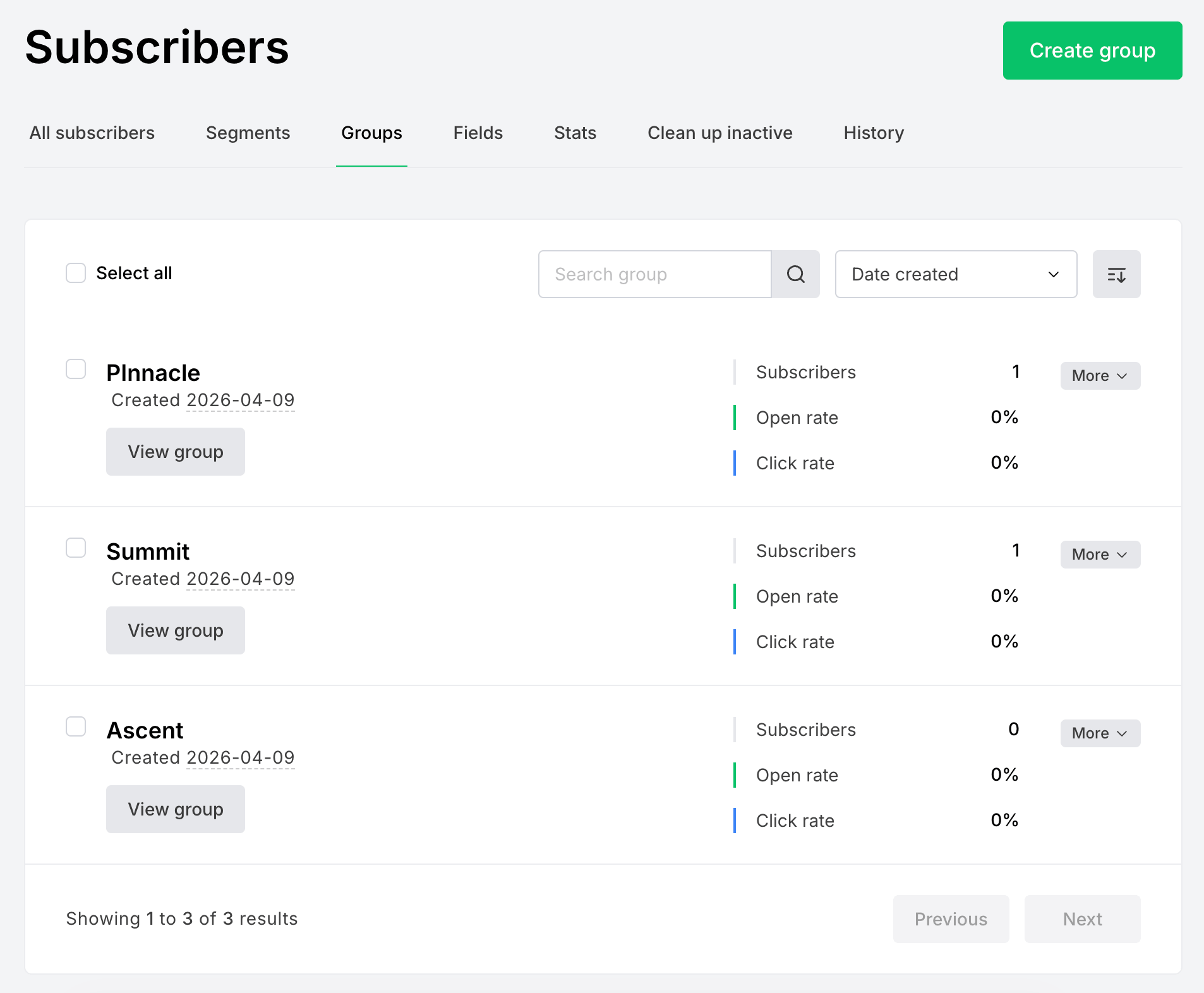
In MailerLite, a group is a list of subscribers you can send a campaign to. Navigate to Subscribers > Groups and click Create group for each level you want to email separately. Naming each group after its level keeps things easy to follow. A site with Ascent, Pinnacle, and Summit levels creates groups with those same three names.
It also helps to create one All Members group. You’ll assign it to every level in the next step, so emailing everyone is a single click at send time.
If you want to email people who sign up without paying, give them a free membership level in PMPro and map it to its own group. The integration only syncs people who hold a membership level, so a WordPress account without a level won’t appear in MailerLite.
Assign Groups to Levels and Choose Your Sync Settings
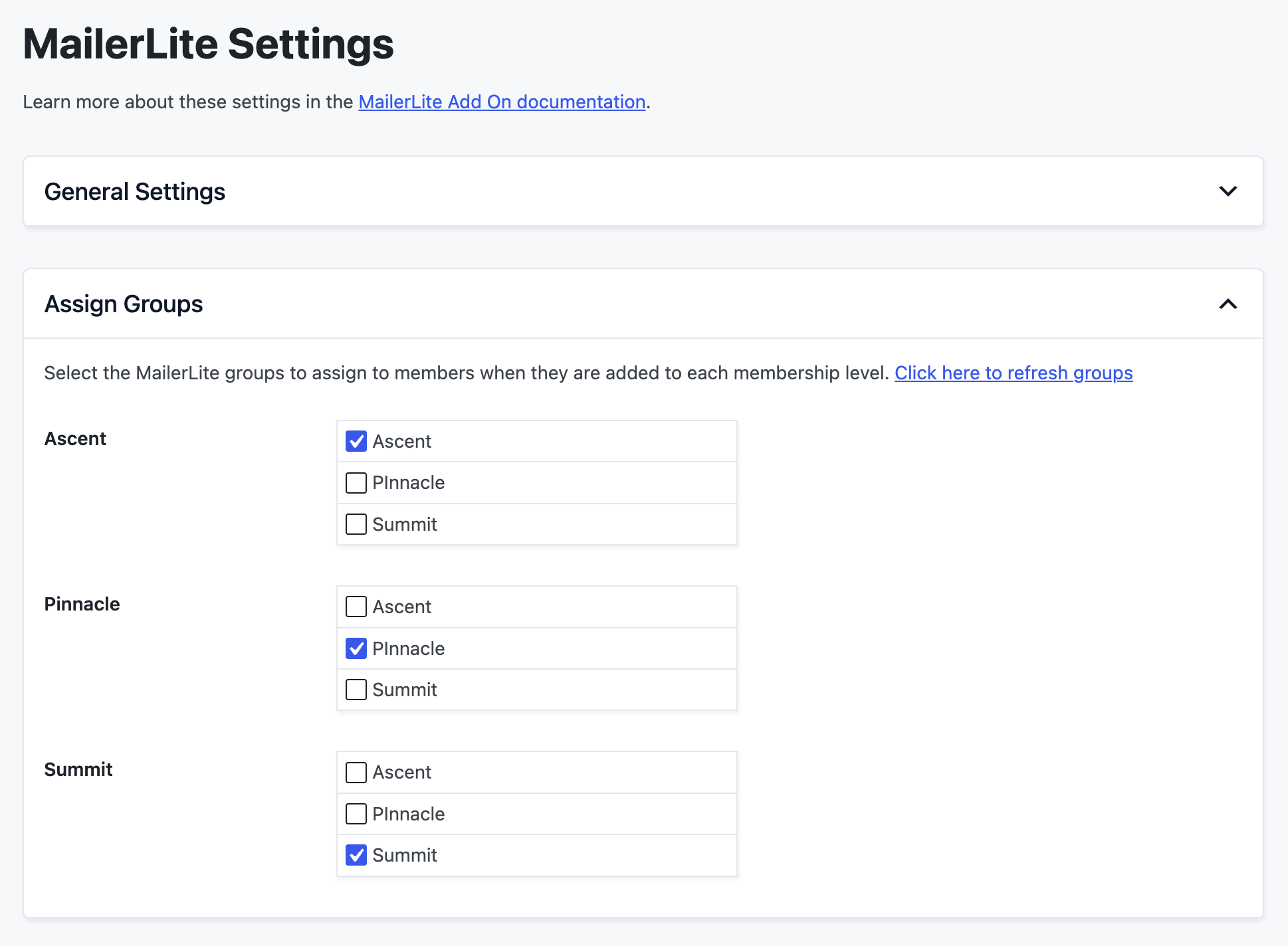
Navigate back to Memberships > MailerLite, then open the Assign Groups section and use the Click here to refresh groups link so your new MailerLite groups appear. Each membership level has its own list of group checkboxes. Check the level’s own group plus your All Members group, then save.
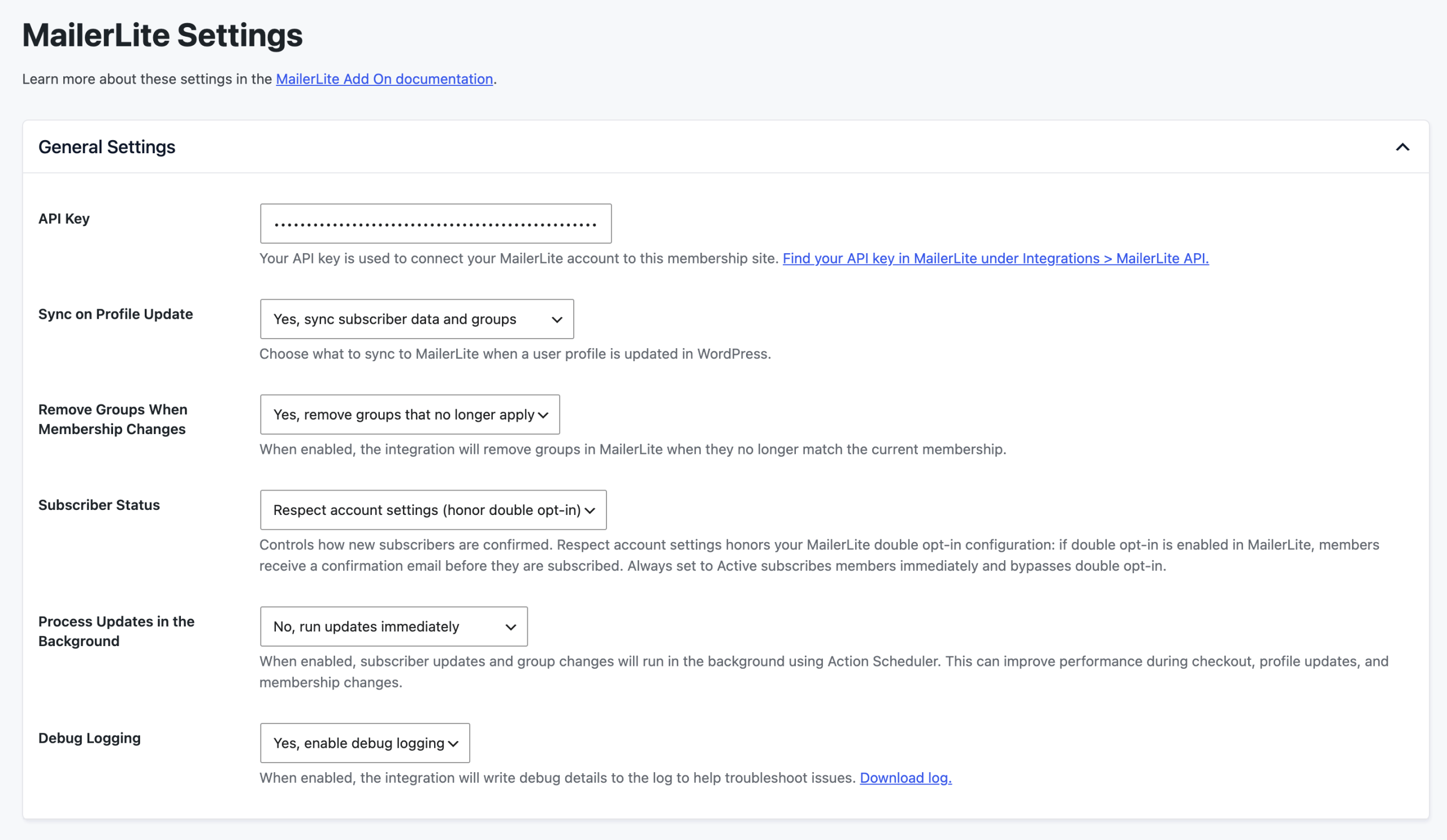
Then open General Settings and work through the sync options:
- Remove Groups When Membership Changes: When set to yes (the default), a member who cancels, expires, or switches levels is removed from groups that no longer match. Leave this on for clean segments.
- Subscriber Status: Choose whether new subscribers follow your MailerLite double opt-in setting or are always set to Active. If you honor double opt-in, members must click a confirmation email before they receive campaigns.
- Sync on Profile Update: Choose whether saving a user profile in WordPress updates their MailerLite data and groups, their data only, or nothing. Syncing data and groups keeps name and email changes current.
- Process Updates in the Background: When set to yes (the default), updates run in the background so checkout and profile saves stay fast.
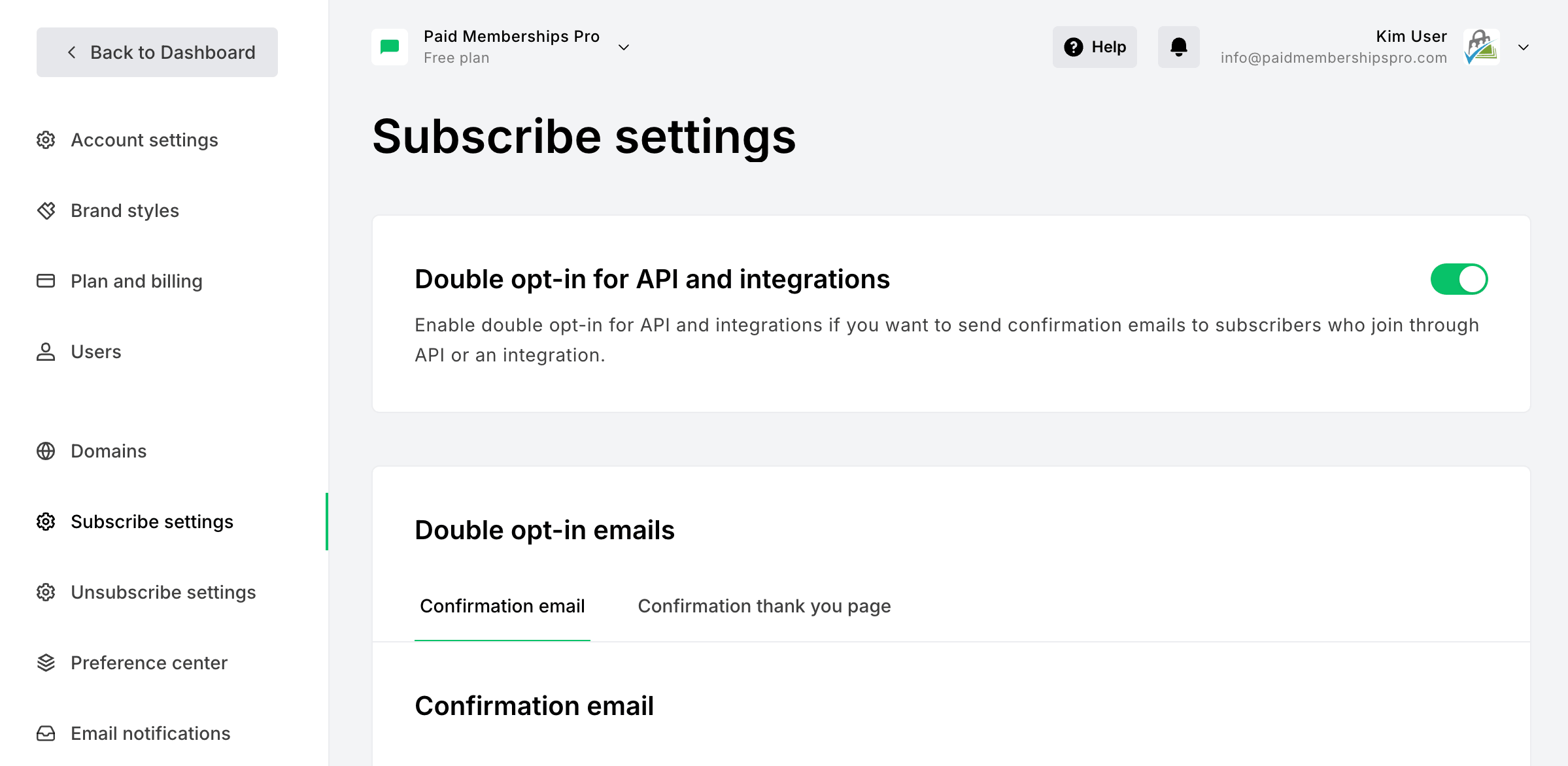
MailerLite controls double opt-in on its side. You’ll find the Double opt-in for API and integrations toggle under Account settings > Subscribe settings. When it’s on and Subscriber Status respects your account settings, every new member gets a MailerLite confirmation email first.
Bring Your Existing Members Into MailerLite
The integration syncs members as their membership changes. It doesn’t go back and add the members you had before you installed it, so this step is a one-time import.
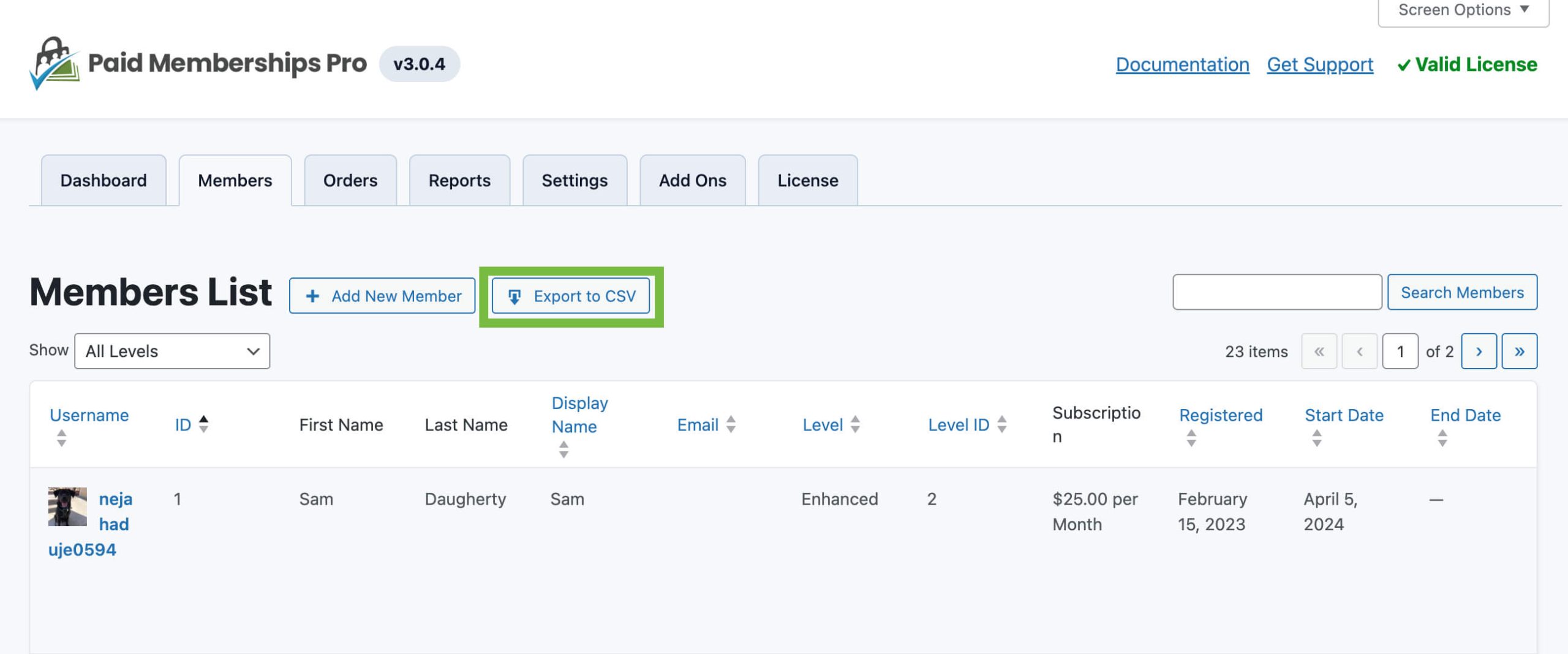
Navigate to Memberships > Members, filter the list by level, and click Export to CSV.
In MailerLite, go to Subscribers > Import subscribers, upload the file, and add those subscribers to the matching level group (and to All Members).
Repeat for each level. From then on, the integration keeps everyone in sync on its own.
To test the connection, edit a member’s profile and save it. With Sync on Profile Update turned on, that member appears in MailerLite with the right groups. With background processing on (the default), give it a moment before you check.
Email All Members or Just One Membership Level
This is where both questions get answered. The steps are the same either way. The only difference is which groups you pick as recipients.
Email All of Your Members
In MailerLite, navigate to Campaigns and create a new regular campaign. Write your subject line, set the sender name and a from address on your own domain, and design your email. When you reach the recipients step, choose your All Members group. If you skipped that group, select every level group instead (Ascent, Pinnacle, and Summit in our example). MailerLite sends one copy to each subscriber, even when someone belongs to more than one selected group.
Email Just One Membership Level
To reach only your Summit members, create the campaign the same way and choose only the Summit group at the recipients step. The subject line, the design, and the send button all work exactly as they did for everyone. You can pick two groups to reach two levels, or build a MailerLite segment when you need something narrower, like Summit members who joined in the last 30 days.
Using a Different Email Tool
The pattern holds no matter which tool you pick. Install the integration Add On, connect it to your account, map each membership level to a list, group, or tag, and send campaigns from the email tool.
Each integration uses its own terms. Mailchimp calls them audiences, Kit uses tags, and Constant Contact uses lists. The Email Marketing Integrations for Paid Memberships Pro roundup covers what each one syncs. For Mailchimp specifically, the member import guide linked above walks through bringing existing members in. If your tool isn’t in the email Add Ons category, use WP Fusion.
What This Setup Unlocks
Once your levels and your email tool are in sync, emailing every member or a single level is the least of what you can do. Here are a few more things the same setup makes possible.
Email New Posts to Members Automatically
Most email tools can watch your site’s RSS feed and send new posts on a schedule. In MailerLite this is an RSS campaign. Point it at the category you publish for members, send it to the right groups, and your members hear about new content without you writing a separate email each time.
Welcome New Members With an Onboarding Series
Build an automation in your email tool that starts when a subscriber joins a level’s group. The first email can point members to their most useful content, the next can show them a feature they might miss, and a later one can ask how things are going. Each level can get its own sequence.
Win Back Lapsed Members
When a member cancels or expires, the integration removes them from their level groups but leaves them in MailerLite as a subscriber. Create a segment of subscribers who aren’t in any membership group, and you have a list of past members for a “we’d love to have you back” campaign. If people also join your MailerLite list from other forms, add a group or tag for those sources so they don’t end up in your win-back segment.
Remind Members Before They Renew or Expire
Renewal and expiration notices are transactional email, so PMPro should send them. Review them under Memberships > Settings > Email Templates. If you want more than one warning before a membership expires, the Extra Expiration Warning Emails Add On is what you need.
See Who Opens, Clicks, and Unsubscribes
Your email tool tracks opens, clicks, bounces, and unsubscribes for every campaign. That reporting is one of the biggest reasons to send from a dedicated tool, and it’s something WordPress can’t give you on its own.
Common Mistakes to Avoid
- Sending marketing email from WordPress directly: Even a small list can hurt your deliverability. Use an email tool for anything you send to a group.
- Turning off Remove Groups When Membership Changes by accident: Members who downgrade or cancel keep receiving emails meant for the level they left.
- Forgetting to import existing members: The integration syncs changes going forward. Members who joined before you installed it won’t appear until you import them.
- Not planning for double opt-in: If your MailerLite account requires confirmation, members who never click the confirmation email won’t receive your campaigns. Decide on the Subscriber Status setting before you launch.
Frequently Asked Questions
Yes. Your email tool sends marketing campaigns, but your site still sends checkout confirmations, receipts, and password resets. Route those through an SMTP service with the SMTP Integration Add On, or use hosting that includes transactional email, like PMPro Max.
With Remove Groups When Membership Changes turned on, the integration removes them from groups that no longer match their membership and adds them to the groups for any new level. They stay in MailerLite as a subscriber, so you can still reach them with a win-back campaign.
Yes, if they hold a free membership level. Create a free level in Paid Memberships Pro, map it to its own group, and send to that group like any other level.
No. When you send one campaign to several groups, MailerLite sends a single copy to each subscriber.
Yes. Create a membership level for newsletter subscribers, map it to a group, and send each issue as a campaign to that group. When someone stops paying, the integration removes them from the group automatically.
Next Steps
Your email tool now has a list of your members, organized by what each person pays you for, and it stays current on its own. You can email all of them or one level whenever you need to.
Start with the MailerLite Integration, or pick the tool you already use from the email Add Ons category. Still not sure which tool fits your site? Contact our support team and we’ll help you figure it out.
Sell Paid Newsletters on WordPress
Adding a newsletter to your existing membership site? Is a newsletter is the primary thing you want to sell? PMPro has all the tools to help you earn a reliable income without breaking the bank.
We always say, “Own the land your business is built on,” and with paid newsletters this could not be more relevant. With robust free tools like WordPress and PMPro, you can run your paid newsletter on a site you fully own and manage.
We know that a WordPress site has tons of moving parts. Choosing the right plugins, themes, hosting, third party services, design assets, and more can feel overwhelming.
Paid Memberships Pro is the most robust membership plugin to sell paid newsletters. Learn exactly what you’ll get — the plugins, the support, and the training — when you sell paid newsletters on WordPress.

Free Download: The AI-Powered Membership Site Blueprint
Download the free guide: Learn how to plan, build, and grow a membership site using AI as your strategic partner: from buyer persona to launch and beyond.